Steven Mintz Addresses the Issue of Workplace Bullying

Steven Mintz writing in his blog, Workplace Ethics Advice, has some things to say about bullying in the workplace. As an attorney I can tell you with authority that he knows his business

If you believe you are the target of a workplace bully, speak to the person doing the bullying. Similar to sexual harassment in the workplace, a topic of a previous blog, the first step with bullying is to make your feelings known that it is unwanted and unwelcome behavior. While you know it can negatively affect workplace performance, I recommend you not mention that to a supervisor because it might be held against you if the matter gets out of control and a workplace demotion or firing needs to be “justified.” While talking to other employees may seem to be a logical step, be careful who you choose to discuss the matter with as that person might be pressured by the bullier down the road to tell the latter’s side of the story. What should you do? Be sure to keep a log to record when each incident occurred; what was said or done in response to it; and your feelings on the matter. It is a good idea to give a copy of the log to a trusted advisor who can independently attest to the facts down the road if that becomes necessary. This is similar to the protective step I recommend for a whistle-blower, the topic of my next blog.

Steven Mintz

Steven Mintz has been blogging for quite some time. He works hard at it and is well informed. His blog posts are backed up by careful research and a well ordered writing style. I recommend you read his blogs, favorite the site and subscribe. He’s one of the best ethics bloggers on the web.

James Pilant
 

The Tables Are Turned on Murdoch (via The New York Times)

Joe Nocera writing in the New York Times creates an often satirical piece that segues from schadenfreude to celebrating justice. I relished every word and hope you enjoy the piece as much as I did.

These are my two favorite paragraphs, click on them to read the whole editorial.

James Pilant

Throughout his career, Murdoch has never just been satisfied with besting the competition, as most decent businessmen are. He’s not truly happy unless he has his foot on a competitor’s neck and is pressing it downward. Felix Salmon, a blogger for Reuters, unearthed testimony about an executive who ran one of Murdoch’s more obscure divisions. “I will destroy you,” the man told a competitor, according to the testimony. “I work for a man who wants it all and doesn’t understand anybody telling him he can’t have it all.”

One feature of Murdoch’s career is that he’s never played by the rules that apply to other businessmen. That’s one reason I think he seems so shellshocked in those paparazzi photographs: unable in this dire circumstance to make his own rules, he simply doesn’t know how to react or what to do. On Tuesday, when he is excoriated in Parliament, it will be the first time he has ever truly been held to account. It undoubtedly won’t be fun for him. But there are many people who are going to take great glee in his misery — not unlike the way his newspapers have always taken such glee in the misery of others.


Murdoch’s had his way with U.S. politicians also (via CBS News)

John Nichols writing for CBS Opinion argues that Murdoch is just as powerful here as in Great Britain –

Now, with Murdoch’s News Corp. empire in crisis—collapsing bit by bit under the weight of a steady stream of allegations about illegal phone hacking and influence peddling in Britain—there is an odd disconnect occurring in much of the major media of the United States. While there is some acknowledgement that Murdoch has interests in the United States (including not just his Fox News channel but the Wall Street Journal and the New York Post), the suggestion is that Murdoch was more manipulative, more influential, more controlling in Britain than here.

But that’s a fantasy. Just as Murdoch has had far too much control over politics and politicians in Britain during periods of conservative dominance—be it under an actual Tory such as former Prime Ministers Margaret Thatcher and John Major and current Prime Minister David Cameron or under a faux Tory such as former Prime Minister Tony Blair—he has had far too much control in the States. And that control, while ideological to some extent, is focused mainly on improving the bottom line for his media properties by securing for them unfair legal and regulatory advantages.

Nichols is absolutely right. The abuses reported overseas are just a different aspect of the Murdoch empire. The power manipulation done here by Murdoch’s various holdings are far more tragic than anything happening in Britain. However, do not for a moment, let you think I believe that Murdoch’s media empire has not been doing the same things here in this country that got them in trouble in England. I am waiting for the results of the FBI investigation.

Nichols also takes care to point out how Rupert Murdoch toys with American politicians like miniatures in a child’s toy collection –

As in England, Murdoch and his managers have for many years had their way with the American regulators and political players who should have been holding the mogul and the multinational to account. Sometimes Murdoch has succeeded through aggressive personal lobbying, sometimes with generous campaign contributions (with Democrats and Republicans among the favored recipients), sometimes by hiring the likes of Newt Gingrich (who as the Speaker of the House consulted with Murdoch in the 1990s) and Rick Santorum (who as a senator from Pennsylvania was a frequent defender of big media companies), sometimes by making stars of previously marginal figures such as Michele Bachmann.

Former White House political czar Karl Rove, who prodded Fox News to declare George Bush the winner of the disputed 2000 presidential election and who remains a key player in Republican politics to this day, still works for Murdoch, as does former Arkansas Governor Mike Huckabee, a prospective GOP vice presidential candidate.

I wish the public owned a politician or two. It would be a nice change.

James Pilant

Lauren Bloom’s Ethical Take on Rupert Murdoch!

Lauren Bloom has a business ethics blog and regularly comments on ethical issues often concentrating on such issues as keeping your business out of court. As of today, Lauren Bloom has written four different posting on the scandals afflicting Murdoch’s media empire.

The first one was on July 8th and was entitled –  We all bear some blame for The News of the World.

This is the concluding paragraph –

Until now, there’s been an unspoken assumption that rich and famous people, be they rock stars or Royals, deserve to have their dirty laundry aired in public if some clever reporter can sleuth it out. (I disagree, but that’s another post.) TNoW is suddenly being castigated for crossing the line by spying on ordinary people’s grief and worry, but who are we kidding here? TNoW only went after the stories its customers wanted to read. Was TNoW a vile scandal sheet whose management deserves to be raked over the coals for unethical journalism? You bet. But until consumers have the good taste and decency to turn away from that kind of garbage, it’s only a matter of time before another tabloid steps up to take TNOW’s place.

The second posting was on July 14th and was entitled –   Thank you, Rupert Murdoch!

Once again, I quote the concluding paragraph –

For someone who thinks ethics in business are important, Murdoch’s tumble is pure gold. I don’t have to argue in the abstract that ethical lapses can cause a business to lose buckets of money and important opportunities. I can just point to Murdoch – his story tells it all.

The third posting was on July 15 and has the title –  Don’t look the other way  

This paragraph probably conveys the essence of that essay.

It can be tempting for executives to look the other way when employees play fast and loose, especially if those employees create a competitive advantage for the company. Ultimately, however, those same executives will be held responsible when their employees’ misconduct becomes public. Rebekah Brooks just took a hard fall from grace, and Rupert Murdoch himself may not be far behind. News Corporation shareholders are already threatening a lawsuit. This scandal will cost the Murdoch empire millions in legal fees, to say nothing of the harm to its reputation and the value of its stock.

The fourth and most current is today’s posting – Rupert, you just don’t get it! 

This is her concluding remarks – pretty tough.

Murdoch wasn’t responsible for overseeing each of the many employees who work for News Corporation’s dozens of media outlets. But he was responsible for establishing and ethical corporate culture, ensuring that employees received reasonable oversight, and interceding when allegations of serious staff misconduct surfaced five years ago. Rumor has it that News Corporation’s stockholders are furious about management decisions that undermined the credibilityof the corporation and, with it, its stock price. They’re likely to demand Murdoch’s head on a platter, and I’ll bet they’ll eventually get it. Pride goeth, Mr. Murdoch … and it seems that you’re in for one heck of a fall.

I recommend you read all four postings, put Ms. Bloom’s web site on your favorites and consider subscribing.

James Pilant


Fight Against Charter Schools Moves to the Suburbs (via Btx3’s Blog)

The data on students in charter schools is mixed. Most schools do about the same or worse than the public schools they supplement or detract from. While the data strongly suggest that there is not even a wisp of a panacea here for poor schools in city districts, I’m unaware of any data at all that says these schools should be used in rich high performing school districts. When a charter school moves into that area, it would seem to be evidence of what many have claimed all along, that this is more of a privatization movement than any attempt to help students, a way of converting a public good into a private profit.

James Pilant

Fight Against Charter Schools Moves to the Suburbs Charter School advocates have expanded their desire to "corporatize" and privatize education to the suburbs, even pursuing establishing specialized Charter Schools in well to do areas with excellent school systems. Unlike in poor areas where parents have little political clout – suburban residents are pushing … Read More

via Btx3's Blog

A World War One Trench Bomb Thrower!

It looks impressive but I have doubts as to its effectiveness. You can click on the picture and see it full size.

It took considerable chutzpah to sell this things to troops on the front. I hope it either worked or the troops got leave to discuss the item with the war profi — whoops, I mean, manufacturers.

James Pilant

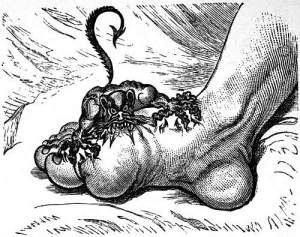
One of my favorite students drew this for me during class!

It’s pretty, isn’t it!

James Pilant

Why we have ethical questions but not answers (via eriktrips)

The author argues that even without an agreed up objective standard of morality, there can still be a discussion of morality based on the “cultural constructions,” – how well the society succeeds in its purposes based on its ideas. This is a particularly significant passage –

What that leaves us with can vary depending on whom one talks to, but among other things, it is possible to critique cultural constructions from within their very constructedness without having to appeal to an objective standard. In fact it is the constructions themselves that are critiqued: arguments and their consequences are not without consequences simply because they are not objective. The real does not dissolve when dualism is questioned but becomes a part of discursive practices that have real effects on real beings whose discursive aspects do not render them less real or less prone to suffering.

I freely admit that I may not understand the argument as well as I should but I am delighted with the idea of still having a “common” ground discussion of a society even without an agreement on what form of morality should be the standard.

James Pilant

As so many do, this post started as a reply to another post elsenet where a writer was quoted about something like the impossibility of an ethics of narrative or what is commonly thought of as postmodernity’s most glaring problem: that of the relativism of its moral arguments, when it has any. Usually when I read the phrase “post-modern ‘anything goes'” it is being written by someone in a field in which postmodern theory does not figure very larg … Read More

via blog@

Cloud on title forever post foreclosure {but wait the Banks own the title companies} (via Timothymccandless’s Weblog)

This is a (fairly outraged and rightfully so) discussion of MERS, the electronic system used by the foreclosure industry to prove ownership of homes. Depending on the state, it proves a little or a lot. It appears as time has gone by that the faults of the system have become more and more obvious.

Of course, many who lost their homes to companies using this system never really got a day in court since this weakness in the ownership status has only recently become well known. This was not fair and that it produces strong feelings of rage and hopelessness is not surprising.

I hope the thoughts here can help some people get justice.

James Pilant

Recently Discovered Flaw in Recording System Clouds Titles on Previously Foreclosed Properties   The modern system of mortgage refinancing and assignments created during the housing boom has left behind a wave of title defects on properties that have ever had a foreclosure in their history, due to a loophole in the property records recording system. This has been detected on a number of properties currently in foreclosure, and found to have … Read More

via Timothymccandless's Weblog

Is the Met copping the consequences? (via Integrity Talking Points)

(When we speak of the Met, what is being referred to is the Metropolitan Police.)

One of the police officials who resigned on Monday had taken gifts and trips from the Murdoch holdings. Since the police are implicated in covering up the crimes of the News of the World and also implicated in providing the scandal sheets with information about crimes and victims, it is not surprising that in hind sight taking these gifts were a mistake.

From the essay – No official in the course of their job, should accept gifts, hospitality or other benefits of any value from anyone other than their employing agency without the explicit consent of their employer. In the vast majority of circumstances, the only reason anyone would give such benefits relates to the exercise of functions by that official – either before decisions are made or following the making of decisions. It is difficult to conceive of a gifting purpose unrelated to either “oiling the wheels” or to recognise the favourable way the wheels have turned for the person making the gift.

If a gift is to be accepted, that acceptance must be transparent. This involves open disclosure to a superior officer, the granting of approval, and formally recording the benefit in a publicly accessible register.

It would be difficult to say it better than this author in these paragraphs.

James Pilant

18 July 2011 The News of the World saga illustrates how any organisation can quickly lose public trust. A media spotlight on the Metropolitan Police over the next few weeks will inevitably have this effect. The resignation of the Commissioner may moderate criticism. The allegations made by the Sunday Telegraph about the Commissioner accepting gifts and hospitality related to the News of the World will challenge the commitment to the ethics polici … Read More

via Integrity Talking Points