Sanitized History is Wrong

We’ve been hearing a lot about our foolish leadership and his desire to limit the Smithsonian’s coverage of the history of slavery because he believes they talk too much about it.

They don’t talk to much about it. What has happened is that historians are really coming to grips with the history of slavery and its long term effects. At various points in my life I have attended college winding up with thirteen and a half years of full time attendance as well as another twelve years or so teaching. In that time, I have seen the teaching of Reconstruction and slavery changing dramatically.

After the Civil War, the defeated confederates did everything possible to make states rights the center of the war’s cause rather than slavery. However, a very casual examination of the issue and a quick look at the newspapers of the revolutionary South demonstrate conclusively that slavery was the principle factor in the rebellion.

After the war, superhuman efforts were made to write a new and highly fictionalized history of the war, the “lost cause” narrative was created and emblazoned across novel after novel and many motion pictures as well. The shock of my white students upon seeing “Judge Priest” with Will Rogers and its utter and complete embrace of the lost cause I found fascinating. My minority students were well aware of that narrative.

The United Daughters of the Confederacy labored for years to sanitize history books, build statues and monuments and to attack any attempt at an accurate depiction of the Civil War. Their statues of traitors and subversives who killed their fellow Americans in the pursuit of the right to enslave others are all over the United States but principally in the South.

Historians are no longer buying into the Confederate sympathizers historical revision. The horrors of slavery began to be discussed honestly in the classroom. I had some of those classes. Slaves were very often maimed to mark them as property. They were murdered for defiance. They were bred like cattle for muscles and size so they could work the land. They were denied education as well as virtually any human right recognized by American law. The idea that they were vital and cherished members of the family is pitiful nonsense.

But above all, the greatest and most significant failure of American history was the fact that the confederate traitors were not punished after the war. Their evil acts and continued defiance had dire results which continue to this day.

And among those dire effects are the desire to censor American history of everything that might detract from a heroic narrative. Nations should not be a subject of worship. A nation is something that a people develop and if they do right be proud of and if they do wrong own up to it.

The glory of America is that we learned from our mistakes. Not only did we abolish slavery, we became leaders in the struggle to end colonialism and many other worldwide evils. Until this year we were the most important nation on earth in the struggle to end hunger and fight disease all thought this has been ended by the pitiful and immoral current regime. In many ways we have learned from our history and become a better and greater people.

That we do right is our glory and our legacy not some nonsensical made up history where everything was good and great in spite of facts and knowledge.

The United States is a great nation because it learns from its mistakes not by denying them.

James Alan Pilant

Defying Kennedy.

We don’t see a lot of courage these days. In the last few months in the United States, law firms, whole industries and universities have bent the knee to the new regime. The American elites that have dominated our society for decades when put to the test of loyalty to nation or self-interest proved themselves to be cowards and curs.

It has been very disappointing. I was under the illusion that I lived in a robust democracy when what I actually live in is a society where many of the most influential and well placed people simply want their money and power without any responsibility to the people and heritage of the United States. They are self-interested, greedy cowards.

(In an Alice in Wonderland world, all ideas are equal. But we live in the real world where ideas have consequences.)

And so we have the current situation where democracy itself may disappear in this nation.

But not everyone has surrendered. Not yet.

RFK, Jr. demanded that “Annals of Internal Medicine” retract a study whose results call into question his ridiculous fringe and conspiracy laden beliefs.

I will not dignify or give any credence to the anti-science ravings of this man. To pretend, that he “might have something,” is another way to assist people in their leap down the rabbit hole of internet nonsense.

I stand on the side of reason, logic and science.

I firmly believe that the study questioned by Kennedy is well founded and provides substantial evidence that anyone who is rational should take into consideration when making decisions about vaccine safety.

But the wonderful part of this sad nonsense is what the Danish researchers did when Kennedy issued his demand.

When confronted by Kennedy’s demands, they said no.

When confronted by the demands of the American federal government that they give way to conspiracy minded nonsense, they said no.

When asked to give up their integrity and surrender to opinions of the foolish and ill informed, they said no.

They stand in defiance to our current nonsensical government. They have backbone and courage.

I wish we had more of these kinds of people here in the United States.

RFK, Jr., Demanded Study on Vaccines and Aluminum Be Retracted—The Journal Said No

https://www.yahoo.com/news/articles/rfk-jr-demanded-study-vaccines-194500702.html

The study in question, published in Annals of Internal Medicine in July, is one of the largest of its kind, looking at 1.2 million children born over more than two decades in Denmark. The authors reported that no significant risk of developing autoimmune, allergic or neurodevelopmental disorders was associated with exposure to aluminium compounds in vaccines.

Annals of Internal Medicine says it stands by the study and has no plans to retract it. Christine Laine, editor in chief for the journal, wrote in a comment on the study’s web page on 11 August that “retraction is warranted only when serious errors invalidate findings or there is documented scientific misconduct, neither of which occurred here”.

A published response was made and I recommend you read all of it.

Anders Hviid, the senior author and an epidemiologist at the Statens Serum Institut in Copenhagen, Denmark’s public-health agency responds in the following post:

Data vs. Doubt: Danish Scientist Responds to U.S. HHS Secretary Critique of Aluminum Vaccine Study

https://www.trialsitenews.com/a/data-vs.-doubt-danish-scientist-responds-to-u.s.-hhs-secretary-critique-of-aluminum-vaccine-study-290120e9

In conclusion, I maintain that our study does not provide support for the hypothesis that aluminum used as adjuvants in vaccines are associated with increased risks of early childhood health conditions. None of the critiques put forward by the Secretary is substantive. Currently, the best way to evaluate this hypothesis is to use observational data and methods. This is what we have done using transparent and rigorous statistical analysis. I categorically deny that any deceit is involved as implied by the Secretary.

Our current regime is an enemy of science, logic and reason. They don’t like to be disagreed with and the idea of independent judgement and actual research fills these liars and mountebanks with fear and trembling.

Their deadliest enemy is the truth.

If we come out of this crisis and return to democratic principles, truth must be the light that guides us.

James Alan Pilant

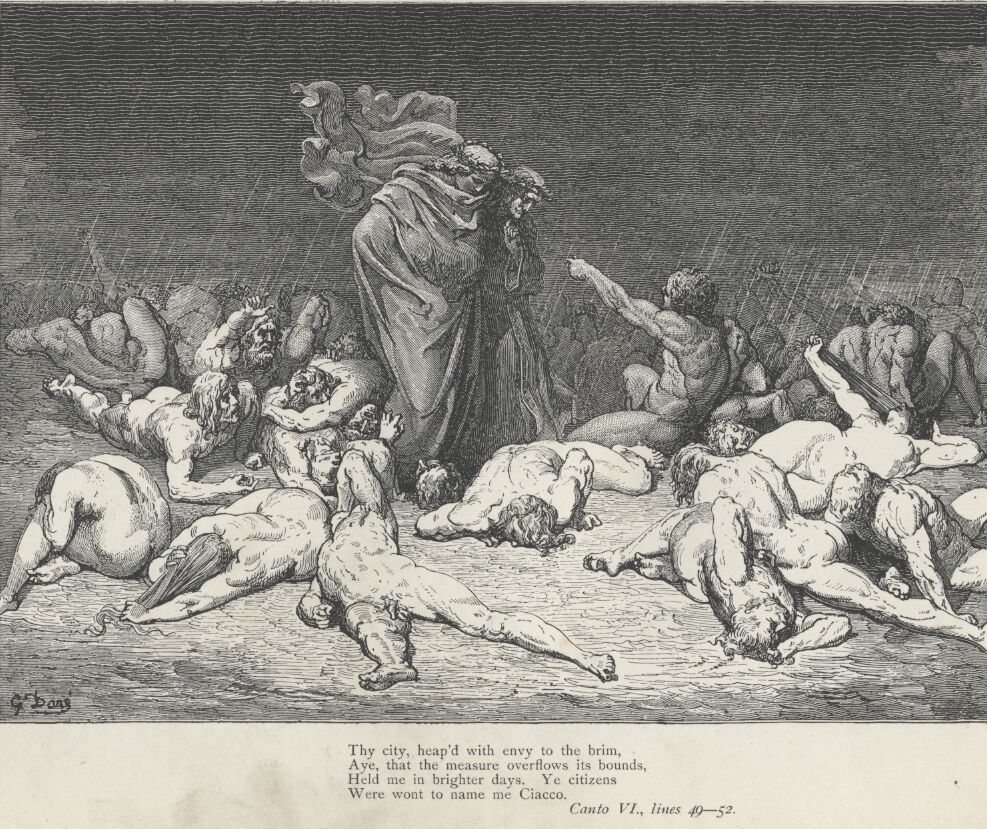
Should Police be Doing Mental Health Calls?

(One of Dante’s visions of Hell.)

No. It is a bad idea and has always been a bad idea.

Police are trained to respond to crimes and have resort to various means of restraint and violence. People with mental health problems are seldom criminals and often have no intent to cause a disruption but they lack the ability to discern the effects of their actions.

Police departments are ill equipped to handle mental health emergencies. These aren’t crimes. These are social problems we no longer treat in facilities because state legislatures got rid of the facilities in the half-baked loony idea that serious mental health problems could be handled on an outpatient basis. This was a massive failure and now the mentally ill wander our streets, are often homeless and provided continuous challenges for states, cities and counties. We’ve known this for years. When you are dealing with the mentally ill, untrained responses can result in death and injury.

This is wrong. The mentally ill should be dealt with by people trained and educated to do so.

Here is New York Mayoral candidate, Zohran Mamdani, suggesting that police no longer bear the burden of mental health calls.

https://www.yahoo.com/news/articles/zohran-mamdani-tells-audience-nypd-020500302.html

(Quoted from the article linked to above.) Democratic mayoral nominee Zohran Mamdani — who has faced heat lately over years-old social media posts critical of the police — came face-to-face with an audience of NYPD officers Tuesday night and told them he would, if elected, spare them the responsibility of responding to most mental health calls.

“We must stop asking them to respond to nearly every single failure of the social safety net,” Mamdani said at Brooklyn’s Grand Army Plaza as a contingent of cops from the nearby 78th Precinct flanked him for an annual “National Night Out” event. “We must stop making it impossible for them to do their jobs by asking them to do every other job we can think of.” (End quote.)

He’s right and I’ve written about this before. Police should not be doing this. If we are going to throw these people onto the streets we should create an organization with facilities to deal with the problems they make.

What is the ethics here?

How about the idea that when a heavily armed (militarized) police force is asked to deal with mental health calls without training or preparation that people are going to die?

Is that a moral problem? You bet.

Let’s build a better nation by dealing with mental health problems like these intelligently and capably.

James Alan Pilant

Morally Right and Just

(A republish of an old column.)

“What is morally just and right – that’s not my job,” he said.

If a rapist, a murderer, an embezzler, any kind of criminal, had said this, we wouldn’t be surprised. If a corporate CEO said it here in the age of Milton Friedman and the Chicago School, I would not be particularly surprised but to hear it from the Chief Justice of the United States Supreme Court is a tragedy and an abomination.

Every human being and, in particular, every American has a responsibility to do what is right and hold others to moral responsibility. That is even more critical in the field of law where what must be a primary concern is justice.

What is particularly bizarre is that he spoke these words in a speech where he repeatedly praised President Lincoln. He said this:

Like most attorneys of his day, Lincoln didn’t go to law school and learned it by reading and working for other lawyers, Roberts said. He was a generalist who studied many things and was continually learning. He understood human nature and had a strong internal compass that allowed him to excel when he believed he was right.

What did President Lincoln say about morality? This is from the his Second Inauguration.

With malice toward none, with charity for all, with firmness in the right as God gives us to see the right, let us strive on to finish the work we are in, to bind up the nation’s wounds, to care for him who shall have borne the battle and for his widow and his orphan, to do all which may achieve and cherish a just and lasting peace among ourselves and with all nations.

Let us as Americans, as believers in one religion or another, as believers in any philosophy in which good is considered more important than evil, struggle to make this land a better place. Let us always remember that we have an affirmative duty to fight evil and a responsibility to do what is right and honor justice whether we are the Chief Justice of the Supreme Court or a simple citizen of a great nation.

James Pilant

The Student Loan Crisis – Is It For Real? (via Go College)

Students now leave college with a debt of around $25,000 dollars a piece. When you choose a job after assuming that kind of debt, do you stay in places with generally low salaries like Oklahoma, Arkansas, Kansas, Missouri, or do you get out and head for the coast where the salaries often run double for the same job? What effect does this brain drain have on the economic development of these states, the viability of their communities and the kind of people elected to public office?

James Pilant

According to their data (Chronicle of Higher Education), of the student loans that entered repayment in 1995, one of every five has since gone into default. That’s correct, fully 20% of those who borrowed could not meet the expectations set forth in their repayment schedule.

Fast Forward to 2010

While one in five is truly scary, one needs to understand that the average student loan debt from that period was roughly $13,000. Today it is nearly double that figure, $23,000 plus.

One might suggest, using simple math, that fifteen years from now we might expect a doubling of the rate of default.

So no, the crisis isn’t hyperbole. According to the Wall Street Journal, “consumers now owe more on their student loans than their credit cards.” According to the June 2010 figures from the Federal Reserve, Americans owe some $826.5 billion in revolving credit. The total owed on student loans comes to $829.8 billion, according to Mark Kantrowitz, publisher of FinAid.org and FastWeb.com.

Over at the Huffington Post, op ed writer Zac Bissonnette noted the Chronicle data and went on to note that defaults are only the tip of the iceberg when it comes to the impact of student loans. Many students who were not in default likely managed to stay in good standing only by accepting career options based on pay instead of goals and lifestyle choices based on debt as opposed to following their heart.

Read More

Student loans leave crushing debt burden (via MSNBC)

When will student loans reach such a size and ferocity in collection that a majority of American students no longer believe it is financially worthwhile to go to college?

Has the American dream simply disappeared for millions of Americans to whom a college education was the gateway to some form of economic security?

James Pilant

The cost of a college education is rising faster than the cost of medical care and as much as three times as fast as consumer prices in general. But that’s just the beginning of the price of admission.

This is the story of a debt crisis few are talking about.

Americans now owe more on their student loans than they do on their credit cards — a debt fast approaching $1 trillion with no end in sight.

Students borrow because they see little choice. A college education, after all, is a key to success. That, it seems, is an article of faith.

Read More

Opinion: The Looming Student Loan Crisis (via AOL News)

For many student loans are a continuing crisis in their lives. Is this kind of debt for millions of Americans sustainable? What are the social effects?

Does the student loan burden keep students away from running for public office, pursuing jobs valuable to society like police, fire and military?

Is this the way, we as a nation should finance our children’s education when that education is so critical to national success and competition?

Read this article and see what you think.

James Pilant

Like home ownership, a college degree used to be perceived as one of the keys to success. Unfortunately, these days it’s starting to look like a gateway to financial ruin.

The Federal Reserve has confirmed that as of June 2010, consumers now owe more on their student loans than on their credit cards.

A separate report reveals that one in five people can’t make their monthly payments.

As a result, Sallie Mae and Citibank have become the arch nemesis of millions, and the country as a whole faces what some warn is America’s next “mortgage meltdown.”

..Read More

Is Access to Social Networking a Measure of a Society’s Freedom? (via The Philosopher’s Eye)

Access to social networking is becoming a measure of freedom, certainly not the main or the only one, but a measure of freedom. And it will become more critical as time goes by.

Everywhere and particularly in the United States, the Internet and social networking are the only remaining avenues of citizen democracy as the rest of the media and the government settle into a single pointless monolith.

My heart goes out to people everywhere on this earth – who suffer the terrible pain to live in countries with the kind of leadership we have now.

James Pilant

Is Access to Social Networking a Measure of a Society's Freedom? In responding to the political demonstrations, the Egyptian government has disrupted internet service and mobile phone services, in the obvious hopes of (a) reducing the volume of testimonies and videos being communicated outside of the country and (b) to disrupt the capacity of the protesters to remain organised and to communicate their progress to the greater population. The BBC reports that both Facebook and Twitter— relied upon by protest org … Read More

via The Philosopher’s Eye

They Make A Wasteland and Call It Healthcare

The Individual Mandate.

President Obama took universal health care and converted it into an insurance company bonanza. The President claims a great victory and says he has accomplished what many Presidents failed to do. Quite a victory. It reminds me of a quote about a war “They take a wasteland and call it peace.” Well we have the wasteland.

We live in a country where you can at penalty of law be forced to buy medical insurance.

It’s a great precedent. Think of all the things Congress might decide you should buy. From the innocuous like an emergency medical kit to disaster insurance (only if you live on the coast) to forced retirement accounts only in Wall Street Investments (We wouldn’t want the Chinese to get American money). The government has the power to force Americans to make any business profitable.

Back in the days before the Civil War, many people called the new industrial workers, “wage slaves.” What does that make us, “insurance slaves?” Taxes are one thing. I understand that civilized societies need to do things, defense, education, etc. But when did business get to collect taxes? Because that’s essentially what this is. The government mandates that you buy a service whether or not you want it. Everyone has to pay out the money, no exceptions. That’s a tax.

Individual responsibility.

They always cry out this one phrase, whenever they take something from you. Now, they say, once you’re buying insurance, you’ll be compelled to act responsibly. No free riders (Brush those teeth, eat right). You’ll be part of the system. I don’t think I have to worry about you being fooled.

This is an insurance company mandate.

There is no universal health care here. Forced consumers are powerless consumers. What do you get when you have no bargaining power? Tell me, if you have a $4,000 deductible, how inclined are you to get medical problems looked after? Not having insurance is a set of problems. They are formidable problems. Having this kind of insurance is a set of problems. They have you like so many rats in a trap. Bewildering sets of rules, denials of insurance claims, endless games and financial penalties aimed at American citizens. There is indeed insurance here, the insurance companies are insured against loss. They are insured against their own incompetence, stupidity and failure.

They’re too big to fail. Could the government allow an insurance company to go under? Wouldn’t that interfere with the smooth delivery of services? What’s a few billion here or there to keep the system running. And the government will have new ways to make insurance companies on the backs of Americn taxpayers.

How about profit? Let’s have a look.

This is a superb post by one of my favorite bloggers, J.N. Nielson on his blog, Grand Strategy: The view from Oregon.

How about the money?

How much cash flow are we talking about as a result of the individual mandate? I did some very rough calculations — literally on the back of an old envelope — and if we take the frequently cited figure of 47 million Americans without health insurance, and divide this by average household size of 2.59, we get more than 18 million uninsured households. I found figures cited between $46,000 and $50,000 as the median US household income in 2010. I took the lower number of $46,000, and found estimates between 7.5 and 12.8 percent of household income to be spent on healthcare (the Urban Institute’s report cited above gives a rate of 2.5 percent, but this is not to be taken seriously). If we pick a number between the two percentages cited, between the high and the low figure, we get about $4,650.00 annually for health insurance per household. This is an unrealistically low number, but I’m doing a conservative calculation. With these conservative numbers, we find that the individual mandate would funnel another 83.7 billion dollars into the coffers of the insurance industry annually. This is cash flow that they can leverage even if they have to pay out a little more than 83 billion in claims.

83.7 billion dollars. Pretty good chunk of change, courtesy of the United States government.

Economic Inequality and Global Elites

What do the global elites think about the issue of inequality (economic disparity)? One clue might be the Global Risks 2011, Sixth Edition. This report is issued by the World Economic Forum –

From Wikipedia

The World Economic Forum (WEF) is a Geneva-based non-profit foundation best known for its annual meeting in Davos, Switzerland, which brings together top business leaders, international political leaders, selected intellectuals and journalists to discuss the most pressing issues facing the world, including health and the environment. Beside meetings, the WEF produces a series of research reports and engages its members in sector specific initiatives

 James Ledbetter writing for Reuters has some thoughts on the subject –

This year’s report makes a big deal about “economic disparity,” which it helpfully defines as “wealth and income disparities, both within countries and between countries.” We used to call this “inequality.” The WEF report rightly points to OECD data indicating real income growth of the top income quintiles in wealthy countries (Finland, Sweden, the United Kingdom, Germany, Italy and the United States) was twice as large as that of the bottom quintiles between the mid-1980s to mid-2000s. The poor may not be getting poorer, but the rich are getting richer at a much faster pace than everyone else. That situation is not only immoral, but dangerous, as it can lead to open conflict between nations and internal political turmoil.

But wait — why is this happening? The WEF report cites “the erosion of employment culture, the decline of organized labor, and failures of education systems to keep pace with the increasing demands of the workplace.” That all sounds plausible, but the time frame cited marks the heyday of the very global governance institutions the WEF seeks to support. You don’t have to accept a causal relationship — though it certainly suggests itself — but at a minimum, global governance institutions have been demonstrably ineffective in addressing the economic structural issues that the WEF now worries about.

I have to disagree on one point. Mr. Ledbetter points out that “the poor may not be getting poorer.” While in these other countries, finland, etc., the poor, the lower classes have kept pace with their previous income. That is not the case in the United States. The middle class here has lost ground, their wages stagnant for three decades and their manufacturing jobs being outsourced as a deliberate policy of the United States government.

I am aware that in an article of that length, he hardly has an opportunity to break it down by country. But I am more local.

To summarize, James Ledbetter’s conclusion, they don’t know what to do about inequality and institutions like theirs do not have the influence to make changes should they suddenly discover the secret of income equality.

When you erode national sovereignty to build international trade and finance, there is no one to deal with issues like income distribution. Now, you might argue that international organizations like the United Nations or the World Economic Forum might fill in the gap. It’s a weak argument. The huge international corporate and financial combines have no intention of yeilding one iota of money or authority to anyone anywhere. And I am cynical enough to believe that military and judicial power trumps economic. If you want to take on an international organization be it organized crime or another kind of organization, use real power, not moral persuasion, not an argument that they should honor stakeholders, you put them in prison, you take their buildings and facilities, you confiscate their money, you leave them no where to hide and you never ever stop chasing them.

Of course, I am not referring to any American corporation.

James Pilant

P.S. The World Economic Forum’s report has been downloaded about 6,000 times. Considering the number of people online, that is not a large number. So I am flying in a high intellectual circles today.