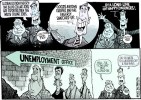
Jayaraman Rajah Iyer comments on “Offshoring has Destroyed the US Economy (via Suzie-Q’s Truth and Justice Blog)”

Jayaraman Rajah Iyer walks his own path and has his own thoughts. Here’s what he things about the afore mentioned post –

Dear JP

US has created a bubble of its own, not just a furious-attack as Krugman says [from WP on the bubble..the response of the right was a furious attack; basically, it was politically incorrect to raise any question about the glorious Bush boom.] but a piranha syndrome on any one who talks against cap… before the ism is even completed, by US – .com, .gov, .edu, .org, in one voice by the dots that stand disconnected otherwise. US.ppl stands completely alienated. An idea when turned over, through a maze of analysts before considered by the CEO led team of experts at a Camp Goliath or some such resorts the incremental cost of the idea is so prohibitive in comparison to the corresponding benefits, that it is thrown in the dust bin. US has expended itself out. No country in the world can afford US Model.

Andrew Comments on “Offshoring has Destroyed the US Economy (via Suzie-Q’s Truth and Justice Blog)”

Andrew often comments on my posts and always has something interesting to say. –

In a lot of cases, the jobs that are going overseas are NOT in job fields that have a shortage of workers. You mentioned manufacturing. Thats the big one.

This is speculation, but I think that outsourcing jobs has actually created a lot of the worker shortages in particular job markets.

My generation, while growing up, was constantly bombarded with this idea that if you did not go to college, then you wont be successful. I think this mentality was partly due to our parents generation seeing those high school level jobs (manufacturing, customer service, technical support, etc) being sent overseas and they wanted to steer their children away from having to look for those types of jobs. An unfortunate biproduct of that panic is that, with everyone going to college, the value of the college degree has fallen. Another consequence is that people, generally, arent interested in going into a skilled labor field (carpenter, welder, electrician, etc.) because they’ve been told over and over again that you need college to be successful. This is CREATING that shortage that proponents of offshoring cite to justify their actions.

Offshoring has Destroyed the US Economy (via Suzie-Q’s Truth and Justice Blog)

That this actually controversial is astonishing. Nevertheless, you there are countless web sites that argue that offshoring was good for everybody.

Despite it’s negative image in first world countries such as the U.S., offshoring has proven to be beneficial to both the business owner and the country where the services are culled.

I think that this issue is much more of a political issue than a job issue. Jobs exist in the United States. In many fields there are shortages of workers. The offshore resources are filling that shortage in some cases. In other cases companies are saving money by using cheaper resources. By saving money, they are making more which is profitable for their shareholders. Who are their shareholders? Probably each and every one of us. Remember your retirement account?

Then, on Feb. 9, the White House released its annual Economic Report of the President. Buried deep on Page 229 of the report was a paragraph noting the growth of offshore outsourcing by U.S. businesses and suggesting this was basically no different from other kinds of international trade:
“The basic economic forces behind the transactions are the same… . When a good or service is produced more cheaply abroad, it makes more sense to import it than to make or provide it domestically.”

I teach college, specifically business law. When my class began to fill up with former manufacturing workers desperate for some kind of work or work related opportunity, I couldn’t help but notice those were the kinds of jobs that made this community, the jobs that made America. It was those jobs that were leaving.

I’ll let the article make the rest of the argument.

James Pilant

Offshoring has Destroyed the US Economy Nobel Economist Michael Spence Says Globalism Is Costly For Americans Dr. Paul Craig Roberts | Global Research | May 31, 2011 These are discouraging times, but once in a blue moon a bit of hope appears. I am pleased to report on the bit of hope delivered in March of 2011 by Michael Spence, a Nobel prize-winning economist, assisted by Sandile Hlatshwayo, a researcher at New York University. The two economists have taken a careful empirical look at … Read More

via Suzie-Q’s Truth and Justice Blog

The Myth of Morality (via Patrick Nathan)

I found this an interesting review with many references to morality. Take this quote below –

Everyone agrees that The Pale King enshrines boredom. What has been glossed over, however, is how fiercely and unrepentantly American these pages are. Yes, the book expounds upon the marvels of boredom and the “heroic” nature of doing a quiet but necessary task without audience or recognition, but juxtaposed are endless descriptions of bureaucracies, American culture at its most dysfunctional, and even extended Platonian dialogues about the decline of American society, complete with terms that never fail to surface in today’s news: “liberal individualism,” “corporations,” “conservatives,” “founding fathers,” “consumer capitalism,” etc. “Americans are crazy,” one character remarks to another: “We infantilize ourselves. We don’t think of ourselves as citizens—parts of something larger to which we have profound responsibilities. We think of ourselves as citizens when it comes to our rights but not our responsibilities.” The selfishness described here again harkens back to Wallace’s speech, in which he revealed that our “natural, hardwired default setting” is to be “deeply and literally self-centered.”

If the reference is to our ethical and moral responsibility, I quite agree. However, the “hard wired” setting to be deeply and literally self centered, is ridiculous, we are just as hard wired to be cooperative and self sacrificing. That being deeply and literally self centered is an American doctrine used to justify cruel and immoral policies and actions. If humans are self centered monsters salivating after every last moment of pleasure and every conceivable possession, than we can justify every kind of lie and cruelty in the name of social control.

Nevertheless, I very much enjoyed the review and I would like you to read it.

James Pilant

My thanks to Patrick Nathan

The Myth of Morality In 2005, novelist David Foster Wallace was invited to give a commencement speech to the graduates of Kenyon College. Captivating, inquisitive, and in no way didactic, Wallace unveiled to them the oncoming drudgery of adult life and all its routines—certainly nothing an ambitious twenty-two year old wants to hear. But Wallace offered an alternative to mental and emotional atrophy. The liberal arts degree, he said, not only teaches us how to think … Read More

via Patrick Nathan

A Quarter of a Century Since Chernobyl (via The Truth Journal)

Twenty-five years. Twenty five years to absorb the lessons of the last nuclear disaster and it just didn’t work out. The ad nauseum repeating of the mantra, “It’s different here.” Whether they meant more modern equipment, better management, more incentives, better regulation, it turned out to be nonsense.

Going back to Chernobyl after all these years is not a comforting journey. It is a trip into a ghostly irradiated land measuring 10,800 square miles, a facet of the aftermath of a nuclear disaster carefully unmentioned by the proponents of nuclear power. That’s about a third the size of Panama or five times the size of Rhode Island. Does that make you comfortable?

How much agricultural land can we afford to lose permanently? We need a thorough intelligent discussion of nuclear power in the United States, not back rooms and lobbyists, a public discussion.

This is a good article and has an attached video.

James Pilant

A Quarter of a Century Since Chernobyl A quarter of a century has passed since the worst nuclear accident in history. On April 26, 1986, the Nuclear power plant at Chernobyl, Ukraine, in the then USSR, exploded leaking nuclear radiation about a hundred times the Nuclear explosion at Hiroshima. I cannot think of anything more but to say that the day reminds us why we should be so proud of Nuclear technology. After all, it allows us to make great changes to the way things work naturally … Read More

via The Truth Journal

Why Business Books Are Helplessly Helpless (via ringingtruenovel)

I enjoyed this essay. I have never been impressed by most business books. The ones I generally read are stories of business collapse, business crimes and business biographies.

I teach business law and I find most of the “how to get ahead in business books” to be mainly nonsense.

The author doesn’t like business book much either and writes about it well.

I recommend you read it.

James Pilant

Why Business Books Are Helplessly Helpless I’ve had a few real jobs that required me to read extensively in the genre of business books. Correction: I’ve had a few real jobs that required me to skim business books. It’s impossible to actually read a business book, because there’s so little there there. When I have to read one, I skip to the end of a chapter and pray that th … Read More

via ringingtruenovel