Lost in the Stacks 4: Writers and Readers (via The Labyrinth Library)

Public Domain

Some days, I do not want to write. I want to do anything but write. My mind says, “Please James, let’s watch a movie, go shopping, have a nap, anything that isn’t typing into that machine.”

I still drag myself to that online beast and write once again. You cannot not post. Your readers will leave, not all of them, but some. And I prize every reader I have. They are like gold coins to a miser. I remember all too well getting 35 hits for the entire month I began posting.

My readers are supportive and kind. Their comments enrich my thought and change how and what I write about.

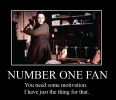
I am greedy for more readers but I don’t want as much encouragement as the picture and caption indicate!

James Pilant

Lost in the Stacks 4: Writers and Readers With the debut of HBO’s “A Game of Thrones” miniseries and a new article in The New Yorker, the strange story of George R. R. Martin and his fans has been on my mind. So, in this episode of Lost in the Stacks, we examine the weird, often dangerously codependent relationship between the Writer and the Readers. What does the writer owe to his or her readers, if anything? What can the readers honestly expect of their writer? What promises, implicit … Read More

via The Labyrinth Library

The Modern Face of Evil (via The Compulsive Explainer)

I’m a big fan of Iniside Job and apparently so is this gentleman. I agree with his remarks. I too believe that the instigators of this calamity were evil, not misguided, not just skirting the edge of legality, but evil.

I hope people like this embrace the concept of evil as a explanation for actions taken for unimaginable greed. This is a difficult time to live in. But one of the reasons we live in difficult times is because it was arranged that way. People were not held accountable for their own actions. Banking institutions did not suffer the results of their mistakes. Thus we have the a country where the free market is cited for every problem and in spite of that a tax supported, profit guaranteed, financial industry with the morals of a rabid dog was protected from it. If you use the mantra of the free market to discourage regulation, you shouldn’t be able to turn around and get taxpayer money.

This is a good post. My thanks to The Compulsive Explainer.

James Pilant

I am watching the movie Inside Job, and I am learning from it. I am watching the handful of guys who wrecked the world’s economy profess to be innocent as lambs. What I couldn’t see was the millions of people who let them get away with it. The modern face of evil is helplessness in the face of power – and people who are only interested in themselves. People who have lost the ability to be good – or to care for others. People who have ceased to ex … Read More

via The Compulsive Explainer

No One Killed Morality! (via Mythbroakia)

This is a well written, thoughtful article. (The title is great by itself.) Journalists are confronted by thorny ethical issues on a continuous basis. He discusses this in very much a reality based manner while still hanging on to virtue.

I liked it. By the way, the site is beautiful. A lot of thought went into the design and it’s visually stunning. So, go and read the article but if you don’t want to, click over just to have a look at the site.

James Pilant

No One Killed Morality! One practical concern in journalistic ethics is that of morality. What is the relation between morality and competence in journalism? Must a good journalist be really morally strong as well? What is meant by morality in the first instance? Is a journalist bound by the standards of ordinary morality? Is there a special journalistic morality that is se … Read More

via Mythbroakia

On rationality and morality, and valuing an individual’s life. (via Musings of a procrastinator)

Pinto

This is a look back at the scandal surrounding the Ford Pinto, a car with a less than stellar reputation. I’m not going into detail. I don’t want to spoil the story.

This article makes some good points and I like it. He’s dealing with one of the most morally charged stories of the twentieth century.

It’s a good story, well handled. Please read it.

James Pilant

Holy crap – two posts in two days? What’s going on? Don’t worry though, this is just as unstructured and pointless as the last. What I give you in quantity, I take back in quality. Anyway, I was in a politics the other day on the subject of Rationality. Basically, the point of the lecture was for us to realise that being ‘rational’ is something that can mean different things. One of the points made in the lecture was that of morality – specifical … Read More

via Musings of a procrastinator

Andrew Comments On My Post: “Could science prove that vanilla is better than chocolate? (via No Right to Believe)”

Andrew has some comment concerning my blog post: “Could science prove that vanilla is better than chocolate? (via No Right to Believe)”

Here are Andrew’s thoughts –

I disagree with Mr. Harris. Science was designed to be descriptive, not prescriptive. In other words, science is meant to describe how things are or how they appear to be. Not how things ought to be.

The scientific method could be used to examine how and why different cultures end up with their specific philosophical values systems. It is not equipped, however, to determine which system is “better” and which ought to be followed.

Sam Harris and the other founders of the New Atheist Movement (NAM) have been trying, for the past few years, to make science into more than what it is. They’ve put it up on a pedestal and seem to be almost worshiping the idea of science as this perfect process for the attainment of knowledge and reason. They’ve run into a few roadblocks, however, when trying to reconcile the notion of morality and “what we OUGHT to do” with the scientific method that they worship. The funny part is, by doing this they fall into the very same philosophical traps that they accuse the followers of religious philosophies and doctrines of doing.

Don’t get me wrong, I’m an atheist as well (not as militant as the NAM though), and I am very familiar with a few areas of science (mainly physics and mechanics) so I know how good of a tool science can be at helping us further our understanding of the universe we live in. Having said that, however, let me emphasis that it does have its limits.

A good example of this is in the topic of nuclear weapons. Science helped us understand how to build the atom bomb. The ethics behind building and using such a weapon, however, is a completely different ball game. As such, we can see that there is more to being human than what science can help us see.

Whether or not science has moral answers I will leave to my readers’ discretion. I am still struggling with the history and basic tenets of moral philosophy. Isn’t John Wayne supposed to have said, “A man’s got to know his limitations.” I try to not in over may head although I’m sure I do at times.

James Pilant

Why Moral Philosophers Aren’t More Moral Than the Rest of Us (via Ockham’s Beard)

Courtesy of Wiki Commons

This is a fun article. Of course, as an ethics teacher I should probably worry, but I will continue to have faith that I will do okay.

I am still working my way through moral philosophy so this article had relevance for me. I hope you enjoy it as well. Read the comments, some of them are pretty fire breathing.

James Pilant

Brace yourself. Or sit down. Or both. Eric Schwitzgebel and compatriots have uncovered a startling revelation: professional ethicists don’t behave any more morally or courteously than non-ethicists. Full abstract of their paper: If philosophical moral reflection tends to promote moral behavior, one might think that professional ethicists would behave morally better than do socially comparable non-ethicists.  We examined three types of courteous a … Read More

via Ockham’s Beard

My Friend, Jen, Argues For Normative Ethics!

My friend, Jen, commented on my earlier post, Personal Change Doesn’t Equal Social Change. He is kind to agree with me but I found his comments significant and I want to share them. So, I present Jen!

I agree with this post, and I think the shift has to start somewhere in education. Business ethics as a discipline needs to evolve beyond what it currently is. Currently, most of business ethics focuses on adhering to laws and other governmental regulation while maximizing profit. There is little motive for taking into account ethical concerns which do not have some sort of legal impetus. This shift will likely happen as slowly as the shift away from ethics and morality in business, but it must begin with education of those who are newly venturing into the corporate world. Business majors, MBAs, etc. need some sort of educational motivation to effect change as they move into the working world, which I believe will come in the form of making business ethics more of a normative field.

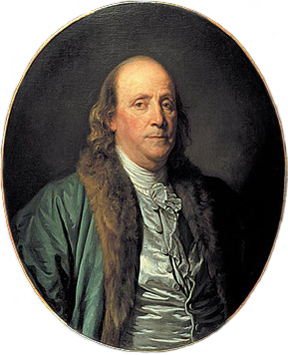
Ben Franklin’s Business Ethics!

I was reading the Harvard Business Review when I came across this gem of an article by a John Paul Rollert. In it, Rollert discusses Franklin’s scheme for moral perfection and the cast of villains and heroes who assisted and obstructed his printing business.

I try to read Franklin’s autobiography at least once a year. After writing the biography he would go on to represent Massachusetts before the king, serve in the Continental Congress, and most importantly, serve on the Committee of Five that created the Declaration of Independence. He then represented the colonies to the French king, was one of three American negotiators for the peace treaty ending the Revolutionary War, and then to culminate his career, serve as a delegate as the Constitutional Convention. In the last years of his life, Franklin became an avid foe of slavery.

The autobiography is, thus, an early picture of Franklin before the world shaking accomplishment that would follow. Reading the book is an interesting experience. Franklin is witty, self deprecating and pridefull (often at the same time), cynical, clever and moral (most of the time). He freely admits that sex was a problem for him (he mentions intrigues with low women) and he believed it necessary for good health.

He is the antithesis of Friedman’s pure focus on profit, being an avid member of the community, supporting and creating in the public sphere constantly. He created organized firefighters, lending libraries, the idea of matching funds, and the development of education. He not only spent his own money, he solicited money from others and was willing to suffer controversy if he felt the cause was just. In short, he was a model American.

He was no shrunken, pale reflections of humanity, the kind that worships the green dollar sign above all other treasures. He loved his country and his fellow man. He was willing to suffer ridicule and danger for his country.

I have three heroes in my life, Benjamin Franklin, Henry Drummond (Inherit the Wind) and Caesar as portrayed in Shaw’s play, Caesar and Cleopatra.

I owe you gentle reader an apology. I have talked much about what I have read and what it meant to me and let Mr. Rollert’s article undiscussed. His writing appears in the Harvard Business Review which by itself speaks well of it and I recommend that you read it and get his take on the business significance of Franklin’s writing.