Chris MacDonald Discusses Loophole Flouting

 Chris MacDonald Discusses Loophole Flouting

Chris MacDonald writing from The Business Ethics Blog is discussing Japanese whaling practices as these actions connect to the larger moral and ethical framework of the nation at large. It’s a good read. I recommend it. If you have time, go to his web site and read the full post (and then sign yourself up as a follower!).

James Pilant

Chris MacDonaldJapan’s loophole flouting is bad for business | The Business Ethics Blog

Japan has flouted the 1986 moratorium on whaling, making use of a loophole that allows whaling for scientific purposes. In effect, the country’s fleet kills whales for what it claims are “scientific” purposes, and sells the meat for human consumption. You don’t have to be an ardent defender of the world’s whales to see the problems inherent in an having a key player in the world’s economy flouting an international standard.

And just think for a minute about that approach to compliance. It effectively means adopting the credo, do what you want, spirit of the law be damned, as long as you can find even the narrowest of loopholes. What example does has the country’s leadership been setting for the business community? How can government ministers look business leaders in the eye and encourage them to cleave to the meaning and intent of regulations? How can the government ask business, without risking hypocrisy, not to make cynical, self-serving use of loopholes?

Naturally, the government of Japan is not alone in this dilemma. The demands of political expediency often mean that political leaders get caught in a do-as-I say, not-as-I-do self-contradiction. But Japan’s stance on whaling seems a particularly blatant example. And the future of the issue still remains unclear. Japan has only committed to cancelling its whale hunt for this year. Time will tell whether the Japanese government, on this issue at least, demonstrates character worthy of emulation, or instead goes back to an approach aimed merely at securing short-term gains.

via Japan’s loophole flouting is bad for business | The Business Ethics Blog.

From around the web.

From the web site, Ethics and the Environment.

http://ethicsandtheenvironment.wordpress.com/2013/06/25/the-purpose-of-this-blog/

The Australian government has taken legal action against Japan over concerns Japanese whaling in the Southern Ocean was not done for scientific purposes.

According to BBC news, the case is been held in the International Court of Justice in The Hague, with Australia arguing that Japan’s scientific whaling program (under which it kills whales) is commercial whaling in disguise. A moratorium which bans commercial whaling was put in place in 1986 by the International whaling commission.

According to The Age, a Melbourne based newspaper, Australia Government counsel Bill Campbell told the court, “Japan seeks to cloak its ongoing commercial whaling in the lab coat of science.”

Mike Double from the Australia Antarctic division told AlJazeera Japan’s scientific whaling was not scientific because whales do not have to be killed to be study.

“We simply do not need to kill whales for the science,” he said. “We can collect all the information we need to conserve and manage these whales through non-lethal methods.”

Attorney-General Mark Dreyfus, who is representing Australia in court, said that more than 10,000 whales had been killed by Japanese whalers since the moratorium was introduced.

He said Australia wanted to see whaling practices halted “once and for all.”

SEC Member Doesn’t Like Shareholder Democracy

108-1SEC Member Doesn’t Like Shareholder Democracy

Some things are the way they are supposed to be. Some things are not. An excellent example is shareholders and corporations. The perspective that most people have in a capitalist, private property system is that if you own a company, your decisions should determine what the company does. And this does happen when the stockholders control very large amounts of stock, for instance, in close corporations. But the influential and powerful corporations often have thousands of stockholders. When the stockholder base is diffused among so many players, it is very difficult for the stockholders to exert effective control.

As a result of this very large corporations tend to operate under CEO leadership with little input from shareholders.

In very large corporations, control by management (a combination of the directors and officers) is maintained with a very small percentage of stock ownership through the use of corporate records and funds to solicit proxies. (Reed, 2010)

Now let’s take a look at the Reuters article.

Any investor who owns at least $2,000 or 1 percent of a company’s stock for a year or more can bring a shareholder proposal, so long as it meets certain requirements. The U.S. Securities and Exchange Commission approved Fredrich’s pitch because it was designed to financially benefit all GE owners and not just him.

That, at least, distinguishes it from resolutions involving environmental, political or social issues that may not serve the interests of shareholders generally. SEC Commissioner Daniel Gallagher, speaking to the annual confab of M&A practitioners last week at Tulane University in New Orleans, argues that “it’s time we asked whether the shareholder proposal system as currently designed is a net negative for the average investor.”

Gallagher, one of two Republicans on the five-member SEC, claims it’s too easy for investors to get resolutions on company ballots. As a result, activists and corporate gadflies “hijack” elections, he says. The commissioner cited statistics showing that a third of proposals come from organized labor and a quarter from social or policy investors and religious institutions.

The upshot is a system that encourages “taking money out of the pocket of someone investing for retirement or their child’s education and using it instead to subsidize activist agendas,” according to Gallagher. The SEC’s rules, he says, should ensure that these activists do not “crowd out every-day and long-term investors” or advance causes “inconsistent with the promotion of shareholder value.”

http://blogs.reuters.com/breakingviews/2014/04/01/rob-cox-ge-should-put-itself-up-for-sale/

Cox, R. (2014, April 1). Rob cox: Ge should put itself up for sale. Reuters, U.S. Edition, Retrieved from http://blogs.reuters.com/breakingviews/2014/04/01/rob-cox-ge-should-put-itself-up-for-sale/

Daniel Gallagher doesn’t like the current system because it’s too easy to get resolutions on company ballots. That is a fascinating conclusion to reach considering the facts.  There 10,033,130,000 shares of GE stock and this year there will be six resolutions for the stockholders to vote on. That number (6) would seem to imply that it is not that easy to get a resolution approved for a shareholder vote. Now, it is not publicly disclosed by the company how many actual shareholders exist but since the number of the shares exceeds the population of this planet by a comfortable margin, there are probably a lot of them. So, a disinterested observer might well think the system wasn’t broke at least in the direction of too many resolutions.

But the best part is the quote from above: “taking money out of the pocket of someone investing  for retirement or their child’s education and using it instead to subsidize activist agendas.” So, when shareholders vote to use their control of their investment, their money, to do something they want rather than maximize profit they’re stealing from children and retirees. It makes one weep that people should vote to decide what to do with their investments.

Gallagher understands that the only reason a corporation exists is to enhance shareholder value, and when some vile activist or corporate gadfly persuades gullible shareholders to do things like invest in America, the natural order of things has been violated and shareholder control must be reined in.

But shareholders have rights in the control of the company because they own it. And democracy is messy. Some people will make illogical or unrealistic proposals. Some will  and have made proposals that Gallagher will not approve of. But investors should be able to make decisions about their company and voting – democracy is the best way to do that. There is no rule from on-high or anywhere else that shareholder value is the only or even the most important goal of a corporation. Stockholders can decide to do something else.

We have reached a point at which stockholders appear to gaining a little more control over the companies they own. There are people, as there always are, who think they know best what should be done with these companies even though they don’t own so much as a single share, because, well, they like Mr. Gallagher, just know.

James Pilant

*Reed, O. (2010). The legal and regulatory environment of business. (15th Edition ed., p. 420). Boston: McGraw Hill Book Company.

Analysis & Opinion | Reuters (There is some content also used above but if that content was removed, the section below wouldn’t make sense. jp)

Gallagher, one of two Republicans on the five-member SEC, claims it’s too easy for investors to get resolutions on company ballots. As a result, activists and corporate gadflies “hijack” elections, he says. The commissioner cited statistics showing that a third of proposals come from organized labor and a quarter from social or policy investors and religious institutions.

The upshot is a system that encourages “taking money out of the pocket of someone investing for retirement or their child’s education and using it instead to subsidize activist agendas,” according to Gallagher. The SEC’s rules, he says, should ensure that these activists do not “crowd out every-day and long-term investors” or advance causes “inconsistent with the promotion of shareholder value.”

He’s right, to a point. It is a waste of time for investors to vet proposals that have nothing to do with the stewardship of their capital. But stifling shareholder speech has consequences. Stricter limits may allow, say, GE to keep a silly measure calling for its sale off the ballot, but they could also prevent owners from voting on more intelligent notions, like splitting the chairman and chief executive roles.

The Supreme Court ruled four years ago that free speech rights apply to corporations under the Constitution, including the right to make campaign contributions to politicians that favor profit-making causes. Shareholders also deserve protection under the First Amendment – no matter how wacky they may sometimes sound.

via Analysis & Opinion | Reuters.

From around the web.

From the web site, Global Corporate Law.

http://globalcorporatelaw.wordpress.com/2012/09/25/shareholder-democracy-and-future-reform/

Writing on the corporate governance blog earlier this month, Bob Tricker observed that “serious”  interest in corporate governance is a recent phenomenon which only came to the fore following Sir Alan Cadbury’s 1992 Report. The dichotomy is that despite the existence of regulatory bodies such as the US Securities and Exchange Commission since the mid-1930s, it was not until problems such as the Enron scandal, the sub-prime crisis and more recent Libor scandal – that “corporate governance” became a buzzword in the business sphere, company law and regulation.

For Tricker, corporate governance  – to which constructs such as marketing, production, finance, operations research, and management information systems have only recently ceded ground – is quickly becoming the focus of a company’s organisational chart. Themes such as the board of directors, executive directors’ remuneration and their relationship with management are all now very much at the apex of the debate about issues such as shareholder democracy, accountability and transparency in the corporate sphere. It is often said that good corporate governance is about promises kept: Macey, Corporate Governance: Promises Kept, Promises Broken (2010). Conversely, bad corporate governance is considered “promise breaking behaviour”.

The UK – which is seen as a “laboratory” for shareholder activism – has high rates of executive remuneration and on average bosses earn seventy five times more than workers.

Ethical Reasoning

I enjoyed this writing and can’t help but believe that there business ethics implications here as well.

bzaharatos's avatarWhat is Called Thinking?

Experimental philosophers and sociologists have become interested in the way in which people attempt to reason about ethical choices. Some of their studies have found that people, and especially Americans, think about ethical choices from a relativistic framework. Such people are called ethical relativists. In short, ethical relativists believe that ethical standards are a matter of personal opinion or taste. So, for example, when one says that it is wrong to cheat or lie, one is simply expressing their opinion with respect to cheating or lying in a particular context.

But ethical relativism is a problematic position. For one, if ethical relativism is true, we are in no position to say that an action performed by others is wrong; after all, if ethical standards are a matter of personal opinion, then it is only one’s opinion that some action is wrong. This has far reaching consequences. It follows that…

View original post 409 more words

Steven Mintz Has Written a Textbook

The Ethics Sage
The Ethics Sage

Steven Mintz Has Written a Textbook

My friend, Steven Mintz, has a new textbook. Below is a segment of the review. Please share my pleasure at the accomplishments of a colleague.

James Pilant

Steve Mintz Accounting Ethics Textbook Reviewed – Ethics Sage

From a review by W. Steve Albrecht in the Journal of Business Ethics, March 2014

One of the book’s great strengths is its excellent cases. The first seven chapters include 10 cases each, many of them famous ethical cases where accountants, executives, and corporate directors have been sued or held liable for their decisions and actions. I have personally been an expert witness in several of the cases covered in the book and so I studied the authors’ treatment of these cases in detail. Their write-ups were always accurate, presented in an interesting manner and provided great references for further study by students. The accuracy of the cases led me to follow up on several of the references cited in the chapters which I also found helpful. My conclusion after reading the book, examining in detail some of the cases and reading the 20 discussion questions per chapter was that this book would work equally well as a stand-alone ethics text or as an excellent supplement in auditing, corporate governance, financial reporting, or other business and accounting classes.

via Steve Mintz Accounting Ethics Textbook Reviewed – Ethics Sage.

From around the web.

From the web site, Cal Poly.

http://www.cob.calpoly.edu/faculty/steven-mintz/

Dr. Mintz enjoys an international reputation for research and teaching ethics in business and accounting. He has published two textbooks the most recent publication is Ethical Obligations and Decision Making in Accounting: Text and Cases. Dr. Mintz has published dozens of research papers in the areas of business ethics, accounting ethics, corporate governance and international accounting. Dr. Mintz teaches courses on accounting ethics and international accounting.

Dr. Mintz develops ethics training programs for organizations. He also develops and teaches continuing education courses in ethics for CPAs. His courses are used in twenty-states to meet their continuing education requirements for re-licensing.

Dr. Mintz is a widely sought out speaker at ethics and academic conferences. He has presented at: The Board of Director and Corporate Governance Research Conference in Henley, England; Global Finance & Research Conference in London; The Institute of Chartered Accountants in Trinidad & Tobago; Association of Asian-Pacific Accountants in Bangkok, Thailand; and the Asian International Business Association in Shanghai, China.

Dr. Mintz writes two popular blogs on ethics issues in business and society (ethicssage.com) and workplace ethics (workplaceethicsadvice). He has been interviewed by the NY Times for his expertise on workplace ethics.

The Gilded Age in Higher Education

007The Gilded Age in Higher Education

David Yamada is here discussing an important topic, that is, the “McDonaldization” of American businesses and institutions, in this case, colleges and universities. I share his concerns. Please visit his site and read not just this article but appreciate the depth of his knowledge in workplace issues.

James Pilant

As U.S. universities embrace the New Gilded Age, what institutions will help us to grow a better society? « Minding the Workplace

Of course, the fate of the public intellectual in higher education has been a subject of debate for some time now, especially since the 1987 appearance of Russell Jacoby’s important book, The Last Intellectuals: American Culture in the Age of Academe. Among other things, Jacoby posited that sharp trends toward narrow specialization in academic scholarship were creating a professoriate that is less relevant to the major public issues of the day.

Yup, one could argue that part-time college teaching jobs, unpaid internships, “non-stipendiary” fellowships, and assorted volunteer gigs offer outlets for expression and creativity. And between individual blogs, sites like The Huffington Post, and free websites, there’s no shortage of online venues for publishing or sharing one’s work.

The problem is that most people have this weird need for food, shelter, and clothing. “Exposure” and “contacts” don’t pay for those basic necessities. A little bit of job security wouldn’t hurt either.

During the coming months, I will devote some space to exploring this and related questions, incorporating a variety of new and emerging voices on public intellectual life in this plutocratic, New Gilded Age. In doing so, I’ll be talking about educators, researchers, activists, practitioners, writers, artists, and others who share a common, understandable concern that our society has no place for them.

As a central part of this inquiry, we need to consider strategies for change. Is it possible to reverse the bad course taken by so many standard-brand universities? Or do we have to think about creating new, sustainable entities that embrace a different, better set of values? If so, how do we go about this?

via As U.S. universities embrace the New Gilded Age, what institutions will help us to grow a better society? « Minding the Workplace.

From around the web.

From the web site, The Homeless Adjunct.

http://junctrebellion.wordpress.com/2013/06/06/inequality-moocs-and-the-predator-elite/

It’s been too long since I’ve written here on The Homeless Adjunct blog, but I am back and ready to move forward.  The silence was caused by a particularly hard year of never-ending job searching.  Two of my three adjunct teaching jobs disappeared, leaving me with barely 30% of what was already a poverty level income.  I suspect that this has had something to do with my outspokenness on the issue of adjunct labor abuse, but as those of you working on contingency contracts all know far too well — there is simply no way to definitively prove such retaliation.  And after a year of falling victim to the severe trauma that we adjuncts are always facing, I have gotten myself back up, and have determined that I won’t let myself be silenced by poverty, or fear.  While it has certainly proven to be an effective tactic, it can only be effective if we allow it to take our spirit along with our income.  It’s pretty clear that this is a Braveheart moment, where I either continue to fight against tyranny — and the corporatized university is a tyrannical institution — or I let them win.

And thanks to the Scottish warrior blood in my veins, I choose to fight.

Parents in New York Tell You Why You Should Opt Out

I’ve been saying these same things for some time now.

dianeravitch's avatarDiane Ravitch's blog

Listen and watch as these parents in New York City tell you why your children should opt out of the state tests.

The high-stakes standardized testing is a massive waste of time. The results come in long after your child has changed teachers.

The teachers learns nothing of value from the tests: just the scores.

The tests have no diagnostic value.

It is a horse race with no point other than to steal instructional time, to rob your child of the joy of learning.

The only way to stop it is to say NO.

Don’t feed the machine.

Remember that your child’s data is being mined even as he or she takes the test.

Say NO.

View original post

Chris MacDonald Discusses Business Ethics and Bribery

Chris MacDonald
Chris MacDonald

Chris MacDonald Discusses Business Ethics and Bribery

A long term blogger on business ethics matters, Chris MacDonald here speaks of the need for international business standard. Please read his post and go to his web site and sign up as a follower.

James Pilant

Bribery is Still a Challenge for International Business | The Business Ethics Blog
Bribery and other forms of corruption continue to pose a challenge to international business. Bribery is a problem because it distorts markets, saps economies, and hurts local communities. For all these reasons, bribery is illegal just about everywhere that has a functioning legal system. And as reported recently in the Wall Street Journal, many countries are stepping up efforts at enforcing anti-bribery laws. Both because of the possibility of prosecution, and because of the slippery slope between bribery and other forms of criminality, bribery poses significant business risks.

Clearly, improved enforcement is an important part of combatting bribery, and combatting corruption more generally. The temptation to win ‘by any means’ will always be there, and so tough rules need to be in place.

But another element is the promulgation and adoption of good, clear, international business standards. As it happens, I’m currently in Madrid as part of the Canadian delegation to an International Standards Organization working committee that is drafting a new “Anti-Bribery Management Systems” standard (ISO 37001).

via Bribery is Still a Challenge for International Business | The Business Ethics Blog.

MacDonald, C. (2014, March 26). Bribery is still a challenge for international business. Retrieved from http://businessethicsblog.com/2014/03/26/bribery-is-still-a-challenge-for-international-business/

From around the web.

From the web site, The Bung Blog.

http://thebungblog.wordpress.com/2012/04/28/time-to-stand-up-for-the-little-guys-girls/

Avid readers of this Blog, (aka gluttons for punishment) will remember my outburst last year. “Government Declares Bribery Not an Offence!”

The tenor of that little tome was to the effect that however sexy the Bribery Act 2010 might have been, it was not perceived as having much relevance, or bite, to the average Jo.

A well respected criminal QC, and good friend of mine, has described it in an article last year as a “Toothless Wonder.”

Much of the cynicism has arisen as a result of the common perception that the SFO being the principal prosecuting authority under the act, has a) no interest in, and b) no budget for, prosecuting anything but the most headline grabbing, stone cold bonkers cases that they can’t possibly lose.

There were dark mutterings from the departing Director that they were hot on the tails of a number of cases, but for now, Mum’s the word. We all await developments on that, especially in the light of the new Director’s protestations that the future of the SFO is secure, and, by implication perhaps, prosecutions are just around the corner. (So’s my Taxi apparently)

To be fair to David Green QC, as a lot of people have been pointing out, it takes time for any substantial case to be detected and investigated to the point of charge, and not being retrospective, the Bribery Act 2010 cannot apply to any act of Bribery committed before July 1st 2011.

Robert Reich On Standardized Testing

“Test taking factories” are less educational institutions and more cash cows for the testing industry.

dianeravitch's avatarDiane Ravitch's blog

Robert Reich posted this on his Facebook page:

Robert Reich

“I’ve been a teacher for most of my life, and few professions are more intrinsically rewarding. Yet I’m troubled by the direction we’re heading in, especially K-12 education. It makes sense for all kids to be brought up to a minimum level of proficiency in English and math, and standardized tests can help insure they are. But we’ve gone way overboard.

“We’re turning our schools into test-taking factories. We’re teaching children how to take standardized tests rather than how to think. The irony is we’re doing this at the very time when the economy is becoming less standardized than ever. Computers and software are taking over all routine, standardized tasks. The challenges of the future require the ability to solve and identify new problems, think creatively outside standard boxes, and work collaboratively with others. An obsessive focus on standardized tests…

View original post 43 more words

How Much is that Money in the Window?

!!439px-Yuan_collectionHow Much is that Money in the Window?

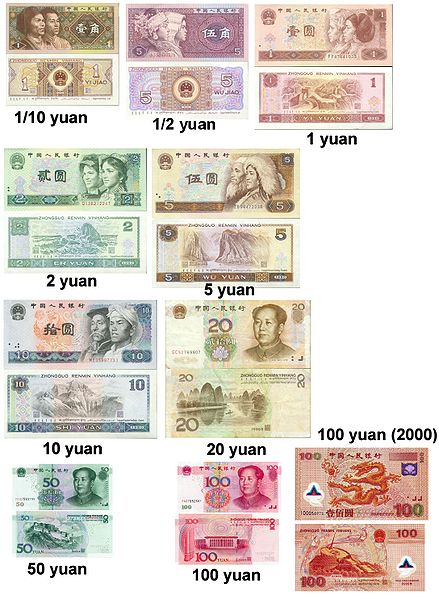
Chinese banks in the rural interior are putting money in their buildings’ windows. This is to indicate to their depositors that there is no need to draw all there money out because, well, there it is.

Should this reassure the rural poor and we Americans in the soundness of the Chinese banking system?

No. This apparent show of transparency and honesty is not that at all but more a three card Monte trick designed to fool the rubes. What proportion of the banks’ actual deposits are in those windows? Is it actually the money from that bank or from a central bank? And how much money is there in those windows? A Juan is worth about 16 cents in this country. Is there a lot of money in those windows or is it more akin to pocket change?

In an organized society, it might be better to rely on banking regulations than cheap publicity stunts to reassure the public. In the background of this story is the collapse last year of two co-ops that served banking functions. Many lost their life savings and now people are worried that once again all their money will disappear into China’s badly regulated, boom and bust, financial system.

If the Chinese want to avoid bank runs, insure the deposits. If you can always get your money whether the bank folds or not, you won’t be out there standing in the rain desperately trying not to be the last one in line. But that would imply a government faith in the banking system that may well not exist. It’s one thing for the poor rural farmers to lose their money and quite another for the government in Beijing to suffer loss

Business ethics is not just good public relations. Business ethics exists in a background of honesty and fair dealing. Sometimes, regulation is a necessary additive to make that honesty self-evident. In our past history, we have seen good banks destroyed by a run on its cash. To protect good banks and all depositors, we have rules. Those rules make for stable banks and reliable customers. However much the free market fundamentalists would prefer the Chinese banking system, our system works better.

I hope I’m wrong about the Chinese banks and that these Chinese, often rural poor, will be able put their money in or take it out as they choose. Banking is an important way of accelerating the benefits of having money. But however this situation develops, it is a cautionary tale of business operating without enough rules.

James Pilant

Chinese banks stack money in windows to quell rumours they have run out | World news | theguardian.com

Rural banks in China‘s eastern city of Yancheng stacked piles of money in plain view behind teller windows to calm depositors queueing at bank branches for a third consecutive day following rumours they had run out of cash.

According to residents of Sheyang county, panic began on Monday with a rumour that a branch of one local bank turned down a customer’s request for a ¥200,000 (£20) withdrawal. Banks declined to comment and Reuters was unable to verify the rumour.

The affected institutions are tiny compared with the scale of China’s financial sector, and the rush for cash appears to be an isolated incident so far. Rumours also found especially fertile ground there after a failure of less-regulated three rural credit co-operatives last January. Yet the news caught nationwide attention, reflecting growing public anxiety as regulators signal greater tolerance for credit defaults.

Miao Dongmei, who runs a baby supply store opposite the branch of the Jiangsu Sheyang Rural Commercial Bank first targeted by depositors, said she kept money at the bank but did not join the stampede. However, she said she had seen other customers carrying baskets full of money out of the bank branch, while armoured cars kept pulling up to deliver fresh loads of currency. Sheyang bank employees told Reuters some branches had been open 24 hours over the past two days.

A visit to one branch showed tellers had stacked bricks of yuan notes immediately behind the glass, piled above head level, and assembled cash piles the size and height of a double bed in the back to show there was enough to go around.

Despite repeated appeals from local officials for calm, by Tuesday the run had extended to another local bank, the Rural Commercial Bank of Huanghai, residents said.

via Chinese banks stack money in windows to quell rumours they have run out | World news | theguardian.com.

From around the web.

From the web site, China Bystander.

http://chinabystander.wordpress.com/2014/03/20/chinas-regulators-show-their-nervousness-about-real-estate-defaults/

Earlier this week, the central bank and China Construction Bank were reportedly discussing the bailout of a developer owing 3.5 billion yuan — believed to be Zhejiang Xingrun — that had borrowed informally at rates of 18-36%. Zhejiang Xingrun is based in Ningbo, one of the cities where government data released earlier this week showed home prices falling. Another is Wenzhou, a shadow banking centre. Two of Zhejiang Xingrun’s owners have been detained by police for what is being described as illegal fundraising.

Separately, the central government’s 2014-20 urbanisation plan released earlier this week calls for a national property database to be set up. This would be a precursor to a new property tax to fund the urbanization plan and to allow local government finance to be reformed. However, it will likely face local footdragging from the many officials who have squirreled away ill-gotten wealth in the form of real estate — even if some of that real estate is starting to look less valuable.

China Bystander. (2014, March 20). China’s regulators show their nervousness about real estate defaults. Retrieved from http://chinabystander.wordpress.com/2014/03/20/chinas-regulators-show-their-nervousness-about-real-estate-defaults/


Saving Bats is Good Economics

Fledermaus, courtesy of wikipedia

Saving Bats is Good Economics

The fledermaus, flying mouse, known in English as bats are a controversial animal. The word I most commonly hear used in a description is “icky.” But bats however much they may generate negative emotions, are natural pesticides and thus, an invaluable aid to human kind. The article below tells of a study demonstrating the benefit of bats to the cotton industry but much the same could be written about many farm products. It would be interesting to generate some data about how bats’ destruction of human pests like mosquitoes enhances our lives.

Preserving species of animals and insects is valuable. We do not know how dependent we are on biological diversity for our health and environment. But bats occupy a wonderful middle ground. They are a species worth preserving because they add to diversity and they are an economic resource whose benefits total millions of dollars even in such a restricted study as that of the cotton industry.

It is always pleasing for me to see the needs of the environment and profits, for once, speaking of the same need to protect a species. This is a problem that is easier to deal with than most in business ethics.

James Pilant

The best reason to protect bats isn’t environmental — it’s economic – The Week

To see how these bats are faring in a changing marketplace, a team of researchers led by University of Arizona ecologist Laura López-Hoffman tracked the value of their pest-control services to cotton growers over an 18-year period. Using the number of insects individual bats consumed nightly, as well as the overlap between bat roosts and cotton fields, the scientists were able to estimate how much value the bats generated by reducing crop damage and insecticide costs.

The team found that over their study period, bats saved an average of 131,385 kg of cotton from damage each year, and saved growers from having to use 32,046 kg of insecticide. But the monetary value of the bats’ bug-killing declined precipitously to $4.8 million in 2008, from a high of $23.9 million in 1990, thanks to falling global cotton prices, the reduction in U.S. cotton growth and, most significantly, the widespread adoption of Bt cotton.

via The best reason to protect bats isn’t environmental — it’s economic – The Week.

From around the web.

From the web site, Bats N Bikes.

http://batsnbikes.wordpress.com/2013/10/20/nocturnal-friends-a-visiting-photographer/

Every night we could go out, Michael went with us. We would set up our nets to catch the bats and other equipment to record bat calls, while Michael set up his extensive high speed camera equipment inside a family-sized tent on the edge of a dirt road, often surrounded by stinging nettles and poison ivy. Each bat we’d catch, we’d record the basics and if s/he was a species of interest, Michael would let an individual bat fly in the tent, catching their precise movements as they swooped around- their mouths open as they sent out calls too high for us to hear, the sounds bouncing back to their ears as they dodge every obstacle in their way. I’m not going to even attempt to go into his set-up because I would only fail to explain the details, but these details and his passion for wildlife photography are the main ingredients to the photos that allow us to witness the beauty of these nocturnal creatures that all too often escapes us.

Bats often only conjure up images of fear, or are rarely thought about. But I want to share some of Michael’s photos from my field season with all of you. Within those few short moments he spent with each bat, he captured what most people never have the opportunity to see up close. Maybe you are reading this because you already love bats, or you are curious, or perhaps you are an excellent friend and enjoy reading what I write. And maybe it’s something else all together. Either way, his photos offer a glimpse into the life of bats and their nocturnal friends- including wildlife photographers and biologists alike.