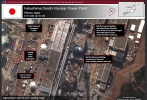
This looks useful! Have a look at it. If anyone has any thoughts, let me know. I can get some more of this kind of thing or less. Let me know.
James Pilant
via Co2 Insanity
This looks useful! Have a look at it. If anyone has any thoughts, let me know. I can get some more of this kind of thing or less. Let me know.
James Pilant
via Co2 Insanity
From Associated Press –
Parts of America’s radiation alert network have been out of order during Japan’s nuclear crisis, raising concerns among some lawmakers about whether the system could safeguard the country in a future disaster.
Federal officials say the system of sensors has helped them to validate the impact of nuclear fallout from the overheated Fukushima reactor, and in turn alert local governments and the public. They say no dangerous levels of radiation have reached U.S. shores.
In California, home to two seaside nuclear plants located close to earthquake fault lines, federal authorities said four of the 11 stationary monitors were offline for repairs or maintenance last week. The Environmental Protection Agency said the machines operate outdoors year-round and periodically need maintenance, but did not fix them until a few days after low levels of radiation began drifting toward the mainland U.S.
What do we measure it for anyway? So, the government can explain with a tiny bit more credibility that they have no idea what is happening in Japan but that there is no danger here? The governments both state and local are committed to nuclear power. It doesn’t matter how much radiation is in the air. It’s what is going to be done.
Not to mention the simple fact, that no matter what radiation is out there, we will be assured it is safe and that it couldn’t happen here anyway.
Do you get tired? Does this get old? The Japanese government lies. The Japanese utility company lies. Our government assures us everything is fine. The nuclear industry hires and persuades every half wit hack to write a pro nuclear piece assuring us that everything is just wonderful.
It’s not wonderful. Changes have to be made in the light of what has happened. You cannot dismiss this as an anomaly.
Nuclear power may be a part of America’s energy future, but this is about as far away from an intelligent discussion as can be imagined.
I cannot tell you how many articles I have had to troll through talking the company line. And to make it more thoroughly, wretchedly disgusting, pretending it is their original thinking and work.
When is there going to be a real national debate not based on corporate PR and a generous helping of campaign money? When is there going to be at least an attempt at deciding with reason and judgment what should be done about nuclear power?
James Pilant
CrisisMaven assures me that this is useful information for dealing with contaminated drinking water. So, I pass it on.
James Pilant
The crisis is on a knife’s edge. The media has moved on to the Libyan bombing. Unfortunately, the reactors have not gotten all better. In fact, they’re like drunk, old former professional baseball pitchers throwing curve balls all over the park.
Keep an eye on this stuff, guys. Everyday is a guaranteed surprise.
James Pilant
via markellis4
Is there a point at which your public pronouncements are so far out of line with reality that not only does no one believe you but there is no remaining benchmark for truth left?
How do you get enough radiation to get hospitalized when you haven’t been near the Fukushima reactors?
Unless there’s a problem at another reactor?
I’ll keep watching.
James Pilant
From BBC –
In another development, two Japanese tourists who arrived in China on a flight from Tokyo are being treated in hospital for high radiation levels.
It remains unclear how the two may have become contaminated as neither traveller is reported to have been within 240km of the Fukushima plant, says our correspondent.
Meanwhile, Chinese news agency, Xinhua, has reported that abnormal radiation levels have been detected on a ship arriving from Japan to Xiamen port in Fujian province.
From The State –
U.S. Sen. Lindsey Graham was home Tuesday, talking about one of his favorite subjects: nuclear energy and why it’s the best way to power South Carolina and America.
Aware that events in Japan have increased concern about nuclear safety, Graham took the media on a tour of Duke Energy’s Oconee atomic power station to show why he thinks nuclear energy needs to be expanded.
Graham said the visit reinforces his belief that a nuclear disaster like that in Japan could not happen at Duke’s three reactors. Graham said the U.S. will learn some lessons from Japan but should not slow the push to develop new reactors.
A few weeks ago Congress just guaranteed all loans made to finance nuclear reactors and agreed to indemnify the owners if they have a meltdown.
Graham said the plant “cannot explode like a nuclear bomb.”
It might be better if it did. A meltdown at a nuclear plant throws hundreds of times more radiation into the environment than a nuclear explosion.
Further down in the article –
“If you showed me a reactor site where there was never a safety concern, I’d be suspicious,’’ Graham said. “The fact that we’re identifying safety concerns independent from the company itself, and the company is getting on top of it, is reassuring.’’
We are “identifying safety concerns independent from the company?” He’s reassured that they don’t have a handle on all their safety concerns? What does he thinks these things are, Easy Bake Ovens?
The senator faced criticism Tuesday from anti-nuclear activist Tom Clements, who disputed that all of the problems were resolved. Clements also said the press event was little more than an attempt to advance an industry on which Graham relies for campaign funds.
Clements gave reporters data showing that Graham has received in the past two years about $40,000 in campaign contributions from those sympathetic to the nuclear industry, such as major power companies. Clements, who is with Friends of the Earth, raised those questions during a press briefing after the tour.
“The reason people in the nuclear power industry support me is because I believe in what they do,” Graham told Clements. “I don’t get any money from your organization because I disagree with you.”
And we close with the basic philosophy of American government. If you give me money you get what you want.
Nuclear energy should not be a major factor in the future of American energy production. Do you know why? It’s too expensive and it requires massive subsidies and insurance from the government. Did I surprise you?
Look at the dollar amounts. Look at the incredible amounts of federal money necessary to launch these giant white elephants. Notice how little discussion is taking place about disposing of nuclear fuel or taking care of shut down plants.
These things are a budgetary disaster of the first magnitude.
Why are we buildng them? The corporations building nuclear power are better organized and have given more money than their competitors. In our government, the decision is almost always determined by campaign contributions not rational analysis.
James Pilant
Americans voting with their “shovels?” This is hardly a statement in favor of nuclear power or disaster preparedness in the United States. Of course, it is probably the American idea that if you throw enough money at a problem you can fix it. (We only believe that now about certain subjects.) It might be better to have a FEMA that we can trust but after the disaster in Louisiana, that kind of trust is never coming back.
James Pilant
A devastating earthquake strikes Japan. A massive tsunami kills thousands. Fears of a nuclear meltdown run rampant. Bloodshed and violence escalate in Libya.
And U.S. companies selling doomsday bunkers are seeing sales skyrocket anywhere from 20% to 1,000%.
Northwest Shelter Systems, which offers shelters ranging in price from $200,000 to $20 million, has seen sales surge 70% since the uprisings in the Middle East, with the Japanese earthquake only spurring further interest. In hard numbers, that’s 12 shelters already booked when the company normally sells four shelters per year.
“Sales have gone through the roof, to the point where we are having trouble keeping up,” said Northwest Shelter Systems owner Kevin Thompson.
From Reuters –
The release of two types of radioactive particles in the first 3-4 days of Japan‘s nuclear crisis is estimated to have reached 20-50 percent of the amounts from Chernobyl in 10 days, an Austrian expert said Wednesday.
That’s not encouraging. The numbers 20 and 50 percent are not as wide a variance as might be thought. They are referring to two different kinds of radiation.
The Austrian institute’s Dr Gerhard Wotawa stressed the two isotopes from Fukushima he had sought to estimate — iodine-131 and caesium-137 — normally make up only one tenth of total radiation.
Based on measurements made at monitoring stations in Japan and the United States, Wotawa said the iodine released from Fukushima in the first three-four days was about 20 percent of that released from Chernobyl during a ten-day period.
For Caesium-137, the figure could amount to some 50 percent.
As someone who on occasion has taught criminal justice classes, one of the more difficult problems you deal with teaching is the misconceptions about police work. Everyone knows all police work. They think. After all it’s on television, dozens of movies. You could even add in a few mystery novels.
Police work is the most dangerous work you can do. There are shoot outs and constant danger.
No, there aren’t. Half of all sworn officers never pull their gun on the job for any reason whatever.
The numbers are straightforward.
Read below.
James Pilant
From MSNBC –
Miners and police officers face many dangers. In 2009, the most recent year for which we have statistics, 101 miners and 97 police officers and security guards died on the job, making for a roughly similar fatality rate of around 13 deaths per 100,000 workers.
From further down in the article.
Still, it does matter what career path you choose. According to the Bureau of Labor Statistics’ (BLS) database, the 10 most dangerous industries to work in are anywhere from six to 60 times as dangerous as the average workplace.
First on the list is fishing, as anyone who’s seen Deadliest Catch on Discovery might guess. In the last year on record, 56 fishermen died, a colossal fatality rate of 200 per 100,000 workers, or 0.2 percent. Loggers and pilots are the only other jobs that come close to being that dangerous, each with 0.006 percent annual death rates. Construction (800 deaths) and transportation and warehousing (586 deaths) registered the largest number of deaths per sector, though their occupational fatality rates hovered around 0.002 percent.
The crisis continues. As I said yesterday, the Japanese utility company and the government are unwilling to give an accurate view of the disaster. So, one day we hear encouraging news which will be partially or totally dispelled by the next day’s news.
From the Associated Press –
(AP) Tokyo’s utility company says black smoke has been seen emerging from Unit 3 of the crippled nuclear plant in northeastern Japan, prompting a new evacuation of the complex. Officials with Tokyo Electric Power Co. said Wednesday that workers from the entire Fukushima Dai-ichi plant have been temporarily evacuated. Operators of the power station have been desperately trying to cool the reactors and spent fuel pools at the plant after it was damaged by this month’s tsunami, which knocked out power to the cooling systems.
You must be logged in to post a comment.